
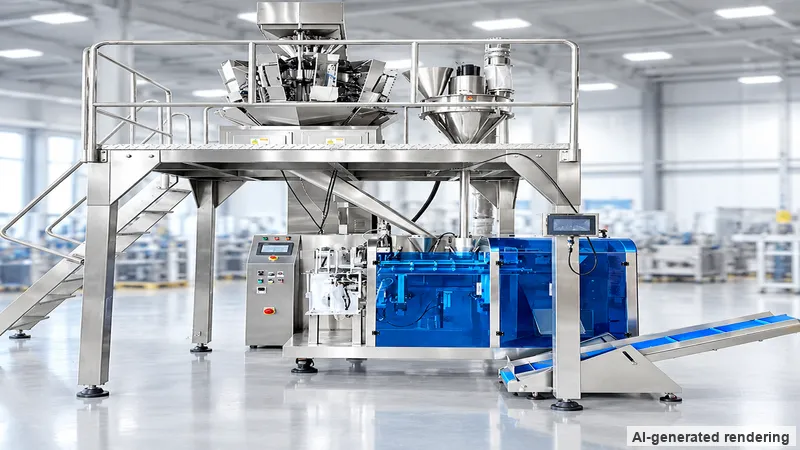
The bag-giving side (给袋式)
- ZS-GW260D — Automatic bag-feeding premade-pouch machine with an auger rotary filler — the machine gives the bag from a magazine, opens it, doses and final-seals it in one cycle.
- Stated speed: 10–50 bags/min
- Stated dose/fill range: 50 g–5 kg; weighing accuracy ±0.3–1.5%
- Stated bag range: Bag size (W × L) 100–260 mm × 110–500 mm; max packaging volume 2500 mL
- Stated power: 220 V / 380 V ±10%, 50/60 Hz; main machine 3.5 kW
- ZS-ASPM4 — Four-head spout-pouch doypack fill-and-cap monoblock — feeds ready-made spout pouches, air-opens them, fills through the spout and caps continuously.
- Stated speed: 1600-1800 BPH
- Stated dose/fill range: 10-300 ml (customizable), stated 1 percent accuracy
- Stated bag range: Spout pouches (spout size: customizable)
- Stated power: 110/220 V, 50-60 Hz; 1200 W; air 0.4-0.6 MPa
The roller sealing side (滚轮式)
- FR-770 — Continuous band sealer — pre-filled bags pass between heated roller-fed bands on a conveyor and exit sealed; the catalog states 0–12 m/min, a 0–300 °C range and a 6–15 mm seal width.
- Stated speed: 0–12 m/min
- No dose/fill range — on this side filling happens upstream or by hand; the machine closes bags that are already filled.
- Stated bag range: Confirm via inquiry
- Stated power: 220V / 50Hz
- ZS-HYS200A/B — Horizontal premade-bag packaging pair — model A pushes product in from one side, model B clamps from both, then the bag seals on the horizontal transport.
- Stated speed: 30-45pcs/min (regarding as materials)
- No dose/fill range — on this side filling happens upstream or by hand; the machine closes bags that are already filled.
- Stated bag range: Bag 50-300mm(L), 50-150mm(W)
- Stated power: 220V, 50Hz, 6.5KW
Where each side wins
- Operator count — bag-giving wins: one integrated cycle from magazine to sealed pouch needs loading and supervision, not filling stations between machines.
- Hygiene exposure — bag-giving wins: the open fill zone exists inside one guarded machine; a roller line has an open filled-bag path between filler and sealer.
- Capital entry — roller sealing wins: the FR-770 closes pre-filled bags at a fraction of the price of a bag-feeding monoblock; a hand-filled or upstream-filled line can start there.
- Product flexibility — roller sealing wins: filling happens wherever it makes sense, so the sealer does not care what went into the bag.
- Throughput with premade pouches — bag-giving wins at scale: the ZS-GW260D states 10–50 bags/min with dosing in the cycle, while a hand-fed roller line is bounded by the feeding human or upstream machine.
- Special closures — bag-giving wins on spout pouches: the ZS-ASPM4 fills through the spout and caps it; roller sealing cannot make a spout closure.
- Layout freedom — roller sealing wins: the sealer is a pass-through conveyor station that slots between existing filling and packing steps.
Confirm before choosing a side
- Who fills the bag today — and who fills it at target volume. Roller sealing assumes a real upstream filling step; its stated speeds seal bags, they do not fill them.
- Bag format: magazine-fed machines need pouch dimensions and stiffness confirmed with the pouch supplier (bag size, stiffness and format are the compatibility gates).
- Seal integrity class: band sealing makes a simple flat seal; the bag-giving machines' final seal is part of a validated cycle — if your spec calls leak testing, say so at inquiry.
- Speeds are condition-dependent (product, bag, film) — the stated figures are each model's own parameter-table values, not guaranteed output on your product.
Every figure above comes from the machine's own gated parameter table on its model page; nothing is asserted from marketing copy. If a cell says "Confirm via inquiry", the parameter is not on record and we confirm it with the builder before quoting rather than estimating.