
Screw capper variants: spindle, elevator-fed or ROPP roll-thread?
"Capping machine" covers machines that solve different cap problems. A screw cap torqued onto a standard neck, a bulk-fed line that must not stop for hand-placed caps, and a pilfer-proof cap whose threads are rolled onto the bottle are three different jobs. The catalog's three inline automatic cappers map onto those jobs one variant each; the table below lines them up with the cap sizes and speeds each model's own parameter table states. Where a figure is not on record, the cell says so instead of guessing.
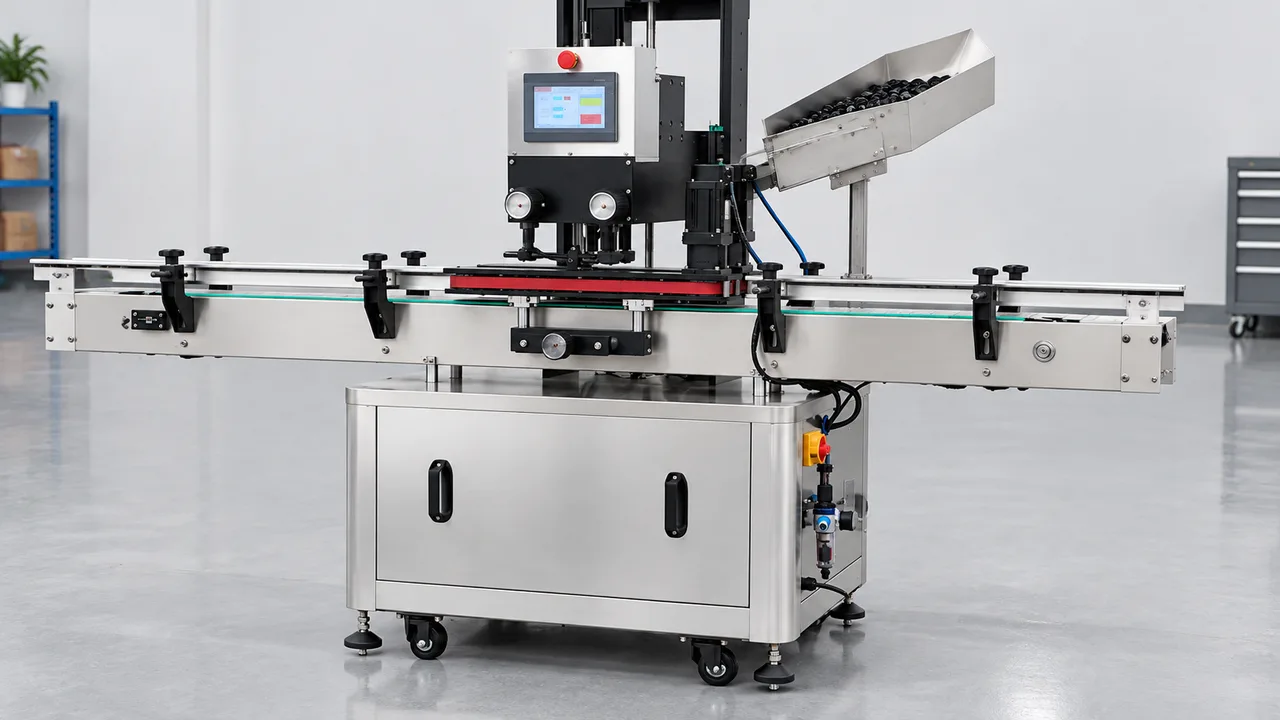
The figures describe the specific models listed on this site, under the source's stated conditions. They are reference points for shortlisting — the final configuration must be confirmed against your actual cap, bottle and production line before purchase.
Cap problem → variant → stated figures
The variant wording follows each model's own catalog description. The first decision is the cap type — a screw cap and a pilfer-proof cap need different heads regardless of speed — and only then does throughput and cap feeding narrow the field.
| Variant | Cap problem it solves (per catalog description) | Cap size (as stated) | Container range (as stated) | Capacity (as stated) |
|---|---|---|---|---|
| ZS-XG440S Inline servo spindle screw capper | Conventional screw caps on plastic, glass and metal bottles — four rubber capping wheels driven by a precision servo spindle screw caps in line. | 20-60mm | Height: 50-300mm, Diameter: 30-120mm | About 30-100 bottles/min |
| ZS-XG441RSL Elevator-fed four-head servo screw capper | Same screw-capping duty with caps bulk-fed: a cap elevator feeds caps to the four-head capping station over the bottle conveyor, so caps are not placed by hand upstream. | 30–80 mm (customizable) | Confirm via inquiry | Approx. 20–60 bottles/min |
| ZS-XG440C ROPP roll-thread capper | Pilfer-proof (roll-on pilfer-proof) caps — servo-driven roll threading forms the cap threads onto the bottle neck, described for wine, beverage and olive-oil bottles. | φ22–38mm | Bottle diameter φ30–90mm, bottle height 100–330mm | 2000 pcs/h |
How to read this table: the two spindle-family variants differ in feeding, not in capping principle — the XG441RSL adds a cap elevator where the XG440S expects caps presented upstream. The ROPP variant reads slower per minute (2,000 pcs/h as stated) because roll-threading forms threads rather than torquing a pre-formed screw cap; the processes are not speed-comparable like-for-like. Cap-size bands overlap but are not identical — the XG440S states 20–60 mm, the XG441RSL 30–80 mm (customizable), the XG440C φ22–38 mm — so match your cap against the band before comparing anything else.
Where the trade-offs are written up
The reasoning behind the variant choice lives in the knowledge base:
- Capping machine types: chuck, snap and spindle cappers — the mechanism-level map that puts the spindle variants and roll threading in context.
- How to choose a capping machine — walking the cap type → machine decision in order.
- Automatic vs semi-automatic packaging machine selection — where the automatic-inline tier pays for itself over a semi-automatic bench.
Shortlisting to configuration
Cap samples, neck finishes and the filling machine the capper must synchronize with all move the answer. Send those with the inquiry and the quotation comes back against your actual configuration — or return to the comparison hub to narrow by task and capacity first.
Request a Quote
Get scope-stated quotes from verified manufacturer partners.
- ✓ Verified manufacturer sourcing
- ✓ OEM & custom solutions
- ✓ Export packing and shipping documentation handled
- ✓ Full packaging line support