
Sealing variants: how should the package close?
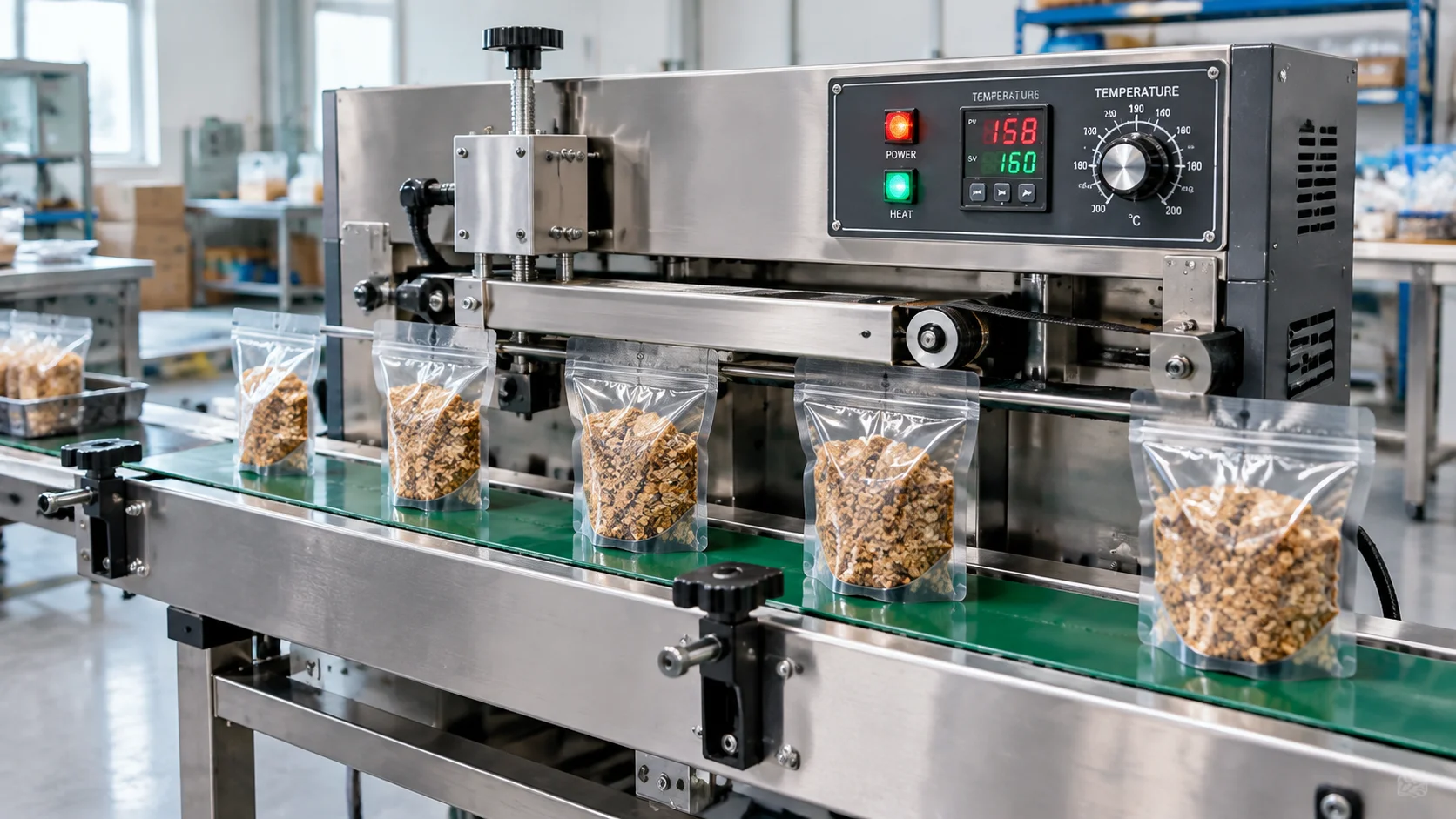
"Sealing machine" covers several machines that share almost nothing once you look at what actually gets closed. A band sealer closes the bag itself; an induction sealer never touches the package, only the foil liner inside the cap; a foil sealer covers the mouth of a jar; a can seamer curls metal against metal without heat; and a tube is closed at its tail — folded and crimped if it is aluminum, ultrasonically welded if it is plastic. The tables below line up one gate-passed machine for each of those answers, with the figures each model's own parameter table states. Where a figure is not on record, the cell says so instead of guessing.
The figures describe the specific models listed on this site, under the source's stated conditions. They are reference points for shortlisting — the final configuration must be confirmed against your actual package, material and production line before purchase.
Closure principle → variant → stated figures
The variant wording follows each model's own catalog description. Start from your package — a bag, a capped bottle, a jar, a metal can, or a tube — and the closure principle column narrows the field to the machines built for it.
| Variant | What gets closed, and how (per catalog description) | Container range (as stated) | Speed (as stated) |
|---|---|---|---|
| FR-770 Continuous band heat-sealing — the bag mouth itself | The package is the film: two heated bands crimp the open mouth of a thermoplastic bag as it travels through the sealer. The catalog states a band speed of 0–12 m/min. | Confirm via inquiry | 0–12 m/min |
| ZS-FK6000A Electromagnetic induction — foil liner bonded inside a bottle cap | The seal lives inside the closure: induction energy bonds the foil liner to the lip of a capped bottle, for Phi20-Phi80 mm caps at 0-10 m/min on a continuous line. | Bottle height 20–280 mm | 0–10 m/min |
| ZS-FKR2T Pre-cut foil sealing — foil applied over the container mouth | A pre-cut piece of aluminum foil film is sealed across the container mouth itself — round or square openings of 50-250 mm sealing diameter — rather than inside a screw cap. | Sealing Diameter: 50–250mm (round or square, customizable) | Approx. 900–1200BPH |
| ZS-CS1 Mechanical double-seaming — metal cans | No heat at the package: a seaming roll curls the lid and can wall together, the way food and paint cans close. The catalog lists cylindrical cans of 40-160 mm diameter at 25-30 cans/min. | Applicable can's diameter: 40–160mm (cylindrical) | 25–30 cans/min |
| ZS-FS80A Fold-and-crimp — aluminum tubes, on a full filling line | The tube is filled first, then its tail is folded over multiple times and crimped closed — for aluminum tubes of Phi10-Phi60 mm at 60-80 tubes/min, as an automatic production-line machine. | Hose Diameter Φ10–Φ60 mm (aluminum tube) | 60–80 tubes/min |
| ZS-FS005U Ultrasonic welding — plastic tubes, semi-automatic bench | Ultrasonic vibration at 20 kHz welds and codes the tail of a plastic tube — 10-50 mm diameter, 50-250 mm height — at 20-30 tubes/min, operated by hand at a bench. | Tube Diameter: 10–50mm; Tube Height: 50–250mm | Speed: 20–30 tubes/min |
How to read the speed column: the six figures are not like-for-like. The FR-770 and ZS-FK6000A state metres of line per minute (0-12 and 0-10 m/min) because both run continuously past the sealing head; the ZS-FKR2T states pieces per hour (about 900-1200 BPH); the ZS-CS1, ZS-FS80A and ZS-FS005U state cans or tubes per minute at three different levels of automation. Match the unit to your line first, then compare within it.
One closure this page does not tabulate as its own row: the same seaming family also covers rectangular and irregular cans — the catalog carries the ZS-CS2 (can height up to 370 mm, 15-20 square cans/min) alongside the cylindrical ZS-CS1, and a double-head vacuum can seamer with lid feeding (ZS-AFK120, sealing diameter Phi70-127 mm) when the can must be closed under vacuum or nitrogen. If your can is not round, start from the ZS-CS2 page instead of the table above.
| Model | Power / supply (as stated) | Footprint (as stated) | List price (as stated) |
|---|---|---|---|
| FR-770 | 220V / 50Hz | 810×370×320 mm | $288 |
| ZS-FK6000A | Less than 1200W; Input AC220V/110V, 50/60Hz; Input current <10A; Output current static <2A, dynamic <7A; Operating frequency 75–85 kHz | About 950×500×460 mm | $679.20 |
| ZS-FKR2T | 110/220V | 2500 × 1000 × 1500mm | $8,199 |
| ZS-CS1 | Motor: 1.5KW | 900×850×2200mm | $6,499 |
| ZS-FS80A | 220V or 380V / 50Hz; motor 2 kW, heating 3.3 kW | 2,500 × 1,200 × 2,400 mm | $34,999 |
| ZS-FS005U | Power Supply: AC220V; Power: 2000W; Frequency: 20KHZ | 1000 × 800 × 1150mm | $10,500 |
The footprint column is where the automation tiers show: the FR-770 states a bench footprint of 810 x 370 x 320 mm, while the ZS-FS80A — a complete filling, folding and sealing line — states 2,500 x 1,200 x 2,400 mm. The two tube-closing rows make the same point from the other side: the ZS-FS80A closes aluminum tubes at 60-80 tubes/min as part of an automatic line, while the semi-automatic ZS-FS005U welds plastic tubes at 20-30 tubes/min by hand. The material of the tube decides the machine before any throughput number does.
Where the trade-offs are written up
The reasoning behind the sealing decision lives in the knowledge base:
- Continuous band sealer vs impulse sealer — the tier decision behind the FR-770's continuous-band principle for small food packaging lines.
- Induction sealing machines for bottle caps explained — how the liner-in-the-cap seal of the ZS-FK6000A works, and when a line needs it.
- Tube filling and sealing machines explained — the fold-and-crimp vs ultrasonic closing decision the ZS-FS80A and ZS-FS005U embody.
Shortlisting to configuration
Package samples (bag film, cap and liner, can lid, or the tube itself), the product going inside, and the upstream filler the sealer must keep pace with all move the answer. Send those with the inquiry and the quotation comes back against your actual configuration — or return to the comparison hub to narrow by task and capacity first.
Request a Quote
Get scope-stated quotes from verified manufacturer partners.
- ✓ Verified manufacturer sourcing
- ✓ OEM & custom solutions
- ✓ Export packing and shipping documentation handled
- ✓ Full packaging line support