
Vacuum or nitrogen? Choosing the atmosphere before the seal
Once you have decided a package must be closed under a modified atmosphere, a second decision follows: vacuum only, vacuum plus a nitrogen flush, or a machine that does both. Vacuum alone removes air from the headspace; adding nitrogen back replaces it with an inert gas so the package keeps its shape and the product is not sitting in a partial vacuum. This page lines up the catalog's gate-passed vacuum-family machines on exactly that axis — a premade-pouch chamber machine, two can machines at different automation tiers, and a dual-mode double-head seamer — with the figures each model's own parameter table states. Where a figure is not on record, the cell says so instead of guessing.
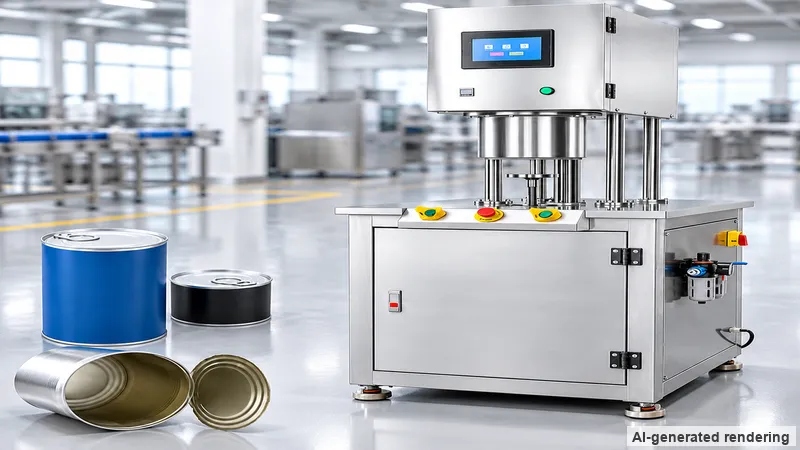
The figures describe the specific models listed on this site, under the source's stated conditions. They are reference points for shortlisting — the final configuration must be confirmed against your actual package, product and production line before purchase.
Atmosphere → container → stated figures
The atmosphere wording follows each model's own catalog name and description. Start from your package — a premade pouch, a can that takes a seamed lid, or a jar that takes an aluminum cap — and let the atmosphere column narrow the field to the machines built for that combination.
| Model | Atmosphere (per catalog) | Container range (as stated) | Speed (as stated) |
|---|---|---|---|
| ZS-AFS210V Vacuum only — premade pouch | The package is a premade pouch, already filled and loaded into the chamber; the machine evacuates the headspace and seals the pouch — no gas flush step in the catalog description. The catalog lists bags of 100-240 × 90-180 mm (L × W) at 15-25 bags/min depending on material and bag size, with nuts, beans, rice and grains named as application examples. | Bag size (L × W): 100-240 × 90-180 mm | 15-25 bags/min (depending on material and bag size) |
| ZS-AFK400 Vacuum + nitrogen flush — cans, bench tier | Both steps in the name: the can is vacuum-sealed and nitrogen-flushed before the aluminum lid is sealed on — sealing diameters of 30-150 mm and sealing heights of 50-180 mm (adjustable) at 4-6 cans/min, on a 220 V / 2 kW bench machine of 200 kg. | Sealing Diameter: 30–150 mm; Sealing Height: 50–180 mm (adjustable) | Sealing Speed: 4–6 cans/min |
| ZS-AFK500 Vacuum + nitrogen flushing — aluminum caps, inline tier | The same vacuum-then-nitrogen sequence closed under an aluminum cap instead of a seamed lid — sealing diameters of 60-154 mm and heights of 60-180 mm, both customizable, at a stated capacity of 5-12 cans/min. The catalog positions it as an industrial in-line machine in 304 stainless steel. | Sealing Diameter: 60–154 mm (customizable); Sealing Height: 60–180 mm (customizable) | Production Capacity: 5–12 cans/min |
| ZS-AFK120 Dual-mode — vacuum alone, or vacuum + nitrogen | One machine, two selectable atmospheres: the catalog states 12-15 jars/min in vacuum sealing mode and 10-12 jars/min in vacuum-nitrogen mode, on a double-head seamer with an automatic lid feeding system — sealing diameter Phi70-127 mm, jar height 100-200 mm. | Sealing diameter Φ70–127 mm; jar height 100–200 mm | Vacuum-Nitrogen Mode 10–12 jars/min; Vacuum Sealing Mode 12–15 jars/min |
How to read the speed column: the four figures are not like-for-like. The ZS-AFS210V states bags per minute and conditions it on material and bag size; the ZS-AFK400 and ZS-AFK500 state cans per minute at bench and in-line tiers respectively; the ZS-AFK120 states jars per minute — and states a different figure for each of its two modes (12-15 in vacuum-only, 10-12 with nitrogen). Compare within a container type first; a pouch rate never converts into a can rate.
The container column carries the second constraint: the ZS-AFS210V is the only machine here whose package is a flexible pouch — the other three close rigid containers, and the ZS-AFK120 alone feeds lids automatically rather than placing them by hand upstream. If your container is outside a stated range (the ZS-AFK500 explicitly offers customizable diameter and height), confirm the tooling against your actual container drawing.
| Model | Power / supply (as stated) | Footprint (as stated) | List price (as stated) |
|---|---|---|---|
| ZS-AFS210V | AC 380 V, 50-60 Hz; 4.5 kW; air ≥0.6 MPa (compressor required, sold separately) | 2111 × 1290 × 984 mm | $11,899 |
| ZS-AFK400 | Voltage: 220 V, 50/60 Hz; Power: 2 kW | 750 × 1030 × 1700 mm | $5,850 |
| ZS-AFK500 | Power Supply: 220 V, 50 Hz, 1.2 kW | 1000 × 1000 × 1800 mm | $23,000 |
| ZS-AFK120 | 380V, 9.12 kW total | 2000 × 1000 × 1720 mm (L × W × H) | $72,999 |
The supply column is where the tiers separate: the ZS-AFK400 runs from a 220 V / 2 kW supply and the ZS-AFK500 from 220 V / 1.2 kW, while the ZS-AFS210V wants a 380 V supply, 4.5 kW and a compressed-air line at 0.6 MPa or better (compressor sold separately), and the ZS-AFK120 totals 9.12 kW at 380 V. The price column tracks the same slope — roughly $5,850 for the bench can machine, $11,899 for the pouch chamber, $23,000 for the in-line cap machine, and $72,999 for the double-head seamer with lid feeding — so the nitrogen function itself is not what moves the number; the degree of automation around it is. List prices as stated: $5,850 (ZS-AFK400), $11,899 (ZS-AFS210V), $23,000 (ZS-AFK500) and $72,999 (ZS-AFK120).
Weight, where stated: the ZS-AFK400 lists 200 kg, the ZS-AFK500 400 kg and the ZS-AFS210V about 650 kg; the ZS-AFK120's weight is not in the catalog record, and that cell is deliberately left to the inquiry rather than estimated. Site readiness — floor loading, supply voltage, compressed air — is a real selection input at these weights.
Where the trade-offs are written up
The reasoning behind the atmosphere and machine-class decision lives in the knowledge base:
- Vacuum packaging machine selection — how chamber machines, tray sealers and thermoform vacuum systems compare for different product types, the class decision behind every row on this page.
- Sealing variants — if your question is one level up (band, induction, foil, seaming or tube closing rather than which atmosphere), start there; this page assumes the vacuum family is already your answer.
Shortlisting to configuration
Package samples (the pouch film or the can with its lid or cap), the product going inside, and the target headspace condition all move the answer — and the nitrogen-flush models should be quoted against your actual gas supply setup. Send those with the inquiry and the quotation comes back against your actual configuration — or return to the comparison hub to narrow by task and capacity first.
Request a Quote
Get scope-stated quotes from verified manufacturer partners.
- ✓ Verified manufacturer sourcing
- ✓ OEM & custom solutions
- ✓ Export packing and shipping documentation handled
- ✓ Full packaging line support